|
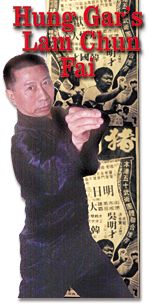
Hung Gar's Lam Chun Fai
by Martha Burr
Bringing
the Hung Family History, Legend and the War Palm to the 21st Century
 My own
personal odyssey back into the Hung Gar legacy was in 1995, when I
traveled with my sifu Buck Sam Kong and his wife Nancy to Hong Kong to
meet his sifu, the venerable Lam Jo. Walking into the small studio in
Mongkok I was overwhelmed with history - the walls were covered with
photos and articles of a century of kungfu people and events. A huge
portrait of Lam Sai Wing dominated one wall, and a rack of well-worn
weapons, including an old kwan dao engraved with a tiger and crane on the
blade, stood in the corner. At 89, si-gung Lam Jo was vigorous and
robust, his handshake strong, and his appetite at yum cha more than
healthy. It was over dim sum and dinner that I was first introduced to
Lam Jo's son Lam Chun Fai. I was struck with his intelligence,
sensitivity, and deep knowledge of kungfu. While he and my sifu caught up
on old times, I had a window into their youth, into the long kungfu
nights in the tiny, intense Hong Kong studio under Lam Jo, young men
taking on the mantle of the Hung Gar heritage. My own
personal odyssey back into the Hung Gar legacy was in 1995, when I
traveled with my sifu Buck Sam Kong and his wife Nancy to Hong Kong to
meet his sifu, the venerable Lam Jo. Walking into the small studio in
Mongkok I was overwhelmed with history - the walls were covered with
photos and articles of a century of kungfu people and events. A huge
portrait of Lam Sai Wing dominated one wall, and a rack of well-worn
weapons, including an old kwan dao engraved with a tiger and crane on the
blade, stood in the corner. At 89, si-gung Lam Jo was vigorous and
robust, his handshake strong, and his appetite at yum cha more than
healthy. It was over dim sum and dinner that I was first introduced to
Lam Jo's son Lam Chun Fai. I was struck with his intelligence,
sensitivity, and deep knowledge of kungfu. While he and my sifu caught up
on old times, I had a window into their youth, into the long kungfu
nights in the tiny, intense Hong Kong studio under Lam Jo, young men
taking on the mantle of the Hung Gar heritage.
Kong remembers Lam Chun Fai visiting him for his tournament in Hawaii in
1974, where they also went out on a short kungfu tour on the island and
in LA, Las Vegas and San Francisco, with their kungfu brother Y.C. Wong.
A black and white photo of the three of them on stage still hangs in
Kong's LA studio. I started my story on Lam Chun Fai two years ago when
we met up once more in Hong Kong at the World Wushu Championships, where
he was an official. He showed me his own Hong Kong studio packed with
kungfu memorabilia, and I had another wonderful yum cha with him and Lam
Jo and his family. My si-bak had fascinating stories to tell, both about
growing up in Hong Kong, and also about Hung Gar's famous master Lam Sai
Wing, Lam Jo's own sifu and uncle. He has since been traveling abroad,
spreading the art of Hung Gar around the world. Here then, begins his
story.
Inheriting Hung Gar's Legend
Growing up in the crucible of kungfu is both a wonderful and a difficult
thing. In Hong Kong, everyone knows the name of Lam Jo. One of the last
living grandmasters of a great generation of what many consider to be
kungfu heroes, he is now in his nineties, and one of the few who can
remember knowing Southern China's famous folk hero Wong Fei Hung. As the
nephew of Lam Sai Wing, Wong's last disciple, Lum Jo lived and breathed
Hung Gar, and went on to dedicate his life to preserving and propagating
the art. Today his son Lam Chun Fai carries the torch, illuminating not
only the legacy of his father, but of the entire lineage as well.
"My name was given by Lam Sai Wing, my great uncle," begins Lam
Chun Fai. "He was born in 1860, and died in 1943, at 83. When my
father was born his parents died, and Lam Sai Wing adopted him. He taught
him everything about dit dar and kungfu growing up. It was very hard. Lam
Sai Wing was a very stubborn guy." Witnessing Lam Jo's own strong
personality, you realize some of this may have been organically nurtured.
Lam Chun Fai started playing kungfu when he was five years old. He
recalls, "At that time, when I was growing up, I had a big interest
in it, and I tried to practice and play better than the other students. At
that time my father trained us real hard, he was very serious. Every
morning we went to the mountain, we lived not far from it on Hong Kong
Island. I'd go up the mountain at 5:30 am. to practice kungfu with my
father and some students. I was 14, 15 years old."
At that time there were many other sifu from different styles that also
trained up on the mountain in the early dawn hours. Lam Chun Fai
remembers, "If my father saw another style, he'd ask me to take a
look first. What is this style? My opinion, he'd ask me. What are his
good points and bad points? How does he play? It was a continual martial
examination. I saw a lot of different styles, different lineages."
This was a skill Lam Jo was passing down to his son, a sort of intuitive
knowledge, an encyclopedic reference of living kungfu. As Lam Jo himself
refined the Hung Gar he learned from Lam Sai Wing, part of his martial
genius was also creating innovations that would become part of his
lineage. Says Chun Fai, "I learned the Double Dragon sword from my
father, he created it. My father was incredibly smart about kungfu, and
very clever when he was young. When he went out to perform at a holiday
or banquet and he'd see other sifu perform, and he could see a set one
time, or two times, and he could remember. The whole set. He didn't learn
from other sifu, only from Lam Sai Wing. But he was good friends with
other sifu, and when they'd perform he learned and had a lot of
knowledge."
Teaching and Bonesetting
Lam Jo's main school was in the Wanchai district of Hong Kong. There were
perhaps 50-60 students in the school at that time. As a young teenager of
15 or 16, every day Chun Fai practiced together with his father, and
helped him run his other two branch schools in Hong Kong, teaching
different nights at different schools. "I also had to train my
brothers and sisters," he notes. "My two sisters and three
brothers all learned kungfu. Later, we all helped my father to teach.
Now, it's only me and my brother. One sister still helps my dad every day
with dit dar."Lam Chun Fai says that at that time if you weren't
playing kungfu well enough, it was because you weren't practicing enough.
When that happened, watch out. "My father would get very mad. He
always tried his best to make us much better. At that time I had no
choice. My father told me I had to help him teach, to help patients in
his dit dar clinic. I cannot say no."
Dit dar, or the art of bonesetting and Chinese medicine, is so closely
tied to the Hung Gar tradition that it is virtually inseparable from it
in Cantonese and Hong Kong culture. Even as a young boy Chun Fai studied
the dit dar alongside his father, inhaling the pungent healing herbs,
feeling injuries in patients to learn about muscle, bone and tendon.
"I learned kungfu and dit dar at the same time," he says.
"If you learn kungfu, you must learn dit dar first. Because in
kungfu you may injure yourself, so it's important to know how to cure
yourself. You must study dit dar for many years to get good
experience."My brothers and sisters would also teach and do dit dar.
My two brothers helped my father with the Kowloon school, and I would
take care of the 3 schools on Hong Kong island. Several of my father's
students, Y.C. Wong and Tang Kwok Wan also helped my father teach at that
time. I taught morning, afternoon and night, 3 classes. If we had any
spare time, we also practiced ourselves. We worked very hard."
Kungfu Society
While Chun Fai's long days were full of school and then kungfu until past
midnight, the martial education continued, but so did the fun and
excitement of being in the eye of the Hong Kong kungfu storm. "When
I was a teenager I always performed in tournaments and doing
demonstrations together with my father. We did the 2 man sets. My
favorite was the dagger and spear with father, it was very fast and
tough, very dangerous, because the spear touches the body a lot. My
father, his students, my brothers - we'd just go out and perform the set,
and edit on the fly." Besides performing, there was a lot of
socializing among the kungfu people at that time. Chun Fai remembers Kan
Tak Hoi was a good friend of Lam Jo's, and many times they would perform
together at banquets, festivals, and charity shows. The Hung family was
friends with Kwan Tak Hing, the famous actor who portrayed Wong Fei Hung
in 100 movies. However, notes Chun Fai, "He didn't play Hung Style.
We performed together when he was more than 60. We asked him to come and
do lion dance."
Kungfu people often came together for fundraisers, to raise relief money
for disasters like floods in China. Whether for charity, holidays or
socializing, there was always another aspect of kungfu performance in
Hong Kong - and that was to show the art to other people. "We'd
always go out and perform with the school," remembers Chun Fai.
"Show the people our style, they'd want to come and learn." As
kungfu popularity grew in the 60's and 70's, Lam Chun Fai remembers the
local Hong Kong shows thrown together by promoters. "They would rent
a theater, and they'd have us performing kungfu and also ask actors and
stars to come sing. It was very popular. When we learned kungfu in the
old days the kungfu movies were not so popular. Only many years later.
When I was 20 a movie producer asked me to do movies and become an actor.
He wanted me to play Fong Sai Yuk. My father said no. Otherwise, I would
do movies. If the first one was OK, then like the Wong Fei Hung series,
they'd make 10-20 pictures. At that time the income was not so good. We
didn't know acting would be so successful later." Nevertheless, he
did make some guest appearances in Hong Kong film later on.
Click Here For PagE II
|