|
Hung Gar's Lam Chun Fai
by Martha Burr
Fight and Insight
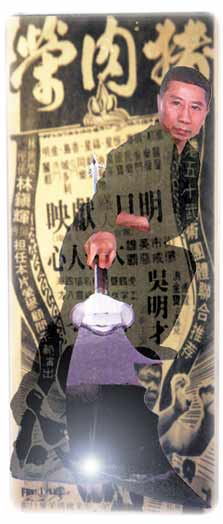 Lam Chun Fai
opened his own traditional Hung Gar kungfu school in Hong Kong when I was
18, continuing the traditions of his father. "Our purpose was not to
fight," he says, "but to make people healthier, and learn
self-defense. Some schools in the old days would tell their students to
go out and fight. Go to the other schools and challenge them. Not us. Lam Chun Fai
opened his own traditional Hung Gar kungfu school in Hong Kong when I was
18, continuing the traditions of his father. "Our purpose was not to
fight," he says, "but to make people healthier, and learn
self-defense. Some schools in the old days would tell their students to
go out and fight. Go to the other schools and challenge them. Not us.
"Other schools would come to our school as well, to challenge us,
challenge my father a lot. My father didn't like teaching free fighting -
kungfu is for health, he would say, not free fighting. But sometimes we
would join the tournaments and then practice for that, but he would not
often teach this."
"At that time we are careful teaching students. When a student
moves, I can tell if he knows kungfu, a lot or a little, and what style.
Karate, Tae Kwon Do, Choy Lay Fut, I can tell. You have to be careful.
Some people come to the school and say, "I haven't learned kungfu
before." Why not say, I learned this style before, and now I want to
learn Hung Gar? Years ago, people only had one sifu. Later, it was OK to
learn from more than one person, but back in the old times, they were
prejudiced against that.
"In Hong Kong today much of that generation has gone. Lam Chun Fai's
kungfu youth became tempered by his bank career, which he retired from
nearly a decade ago to go back to teaching kungfu full time. "Before
1993 I was a bank manager as well. In the daytime I went to the bank, and
afterwards I'd see patients and teach kungfu. I have three kids, they
play kungfu but they don't teach."
On Down the Line
Since his retirement from the bank, Lam Chun Fai has
shifted his teaching - and preserving the art of Hung Gar - into a higher
gear. Freed from a daily schedule, he has been able to travel and give
seminars. And the art that he has closely honed for a lifetime is finding
its way into new hands across the continents, from Greece to Brazil. Both
Lam Jo and Lam Chun Fai are determined that the art will not be lost, and
as many nuances and subtleties of the style will also be preserved. One
of the classic sets created by Lam Sai Wing's father is the War Palm. It
is the set Lam Chun Fai has chosen to teach abroad, as well as to the
many foreign students who travel to Hong Kong to study with him. "In
1994 I went to Harvard University to teach War Palm. I had quit banking
by then, and just wanted to do dit dar and teach kungfu.
In Hong Kong nowadays we teach, but it's difficult, hard to find a center
to teach in. Many sifu don't teach in their own school, because the space
is too small for students to play. I'm teaching more students now, some
students are very interested in this set, and then subsequently in the
whole system."War Palm (Chiu Ju) is a straight Lam Sai Wing set
(have name in characters). Lam Sai Wing learned it from his father, who
was also a Hung Gar stylist. His name was Lam Koi Chun. Lam Sai Wing
studied from a lot of masters, he had had 6 or 7 sifus, and Wong Fei Hung
was the last one. But when he followed Wong Fei Hung he knew his kungfu
was very good. Wong Fei Hung already retired. He didn't want to take any
other student. Lam Sai Wing was a butcher, selling pork, so every morning
he cut the most special part of the pig and gave it to Wong Fei Hung.
Later, Wong says OK, I take you as my last student. He saw Lam Sai Wing
was sincere, diligent, and didn't give up."
The War Palm
In the War Palm, notes Lam Chun Fai, you are
practicing power, hard power. "Lam Sai Wing created the War Palm,
which is very good for practical use. It utilizes hip rotation, working
the waist (jin jong) for power, and turning. It contains techniques not
found in other sets for more practical applications. It develops power
into a twist."
In the War Palm set, Lam continues, techniques are very fierce.
Everything comes from the uppercut - it is very hard to block. You are
cutting from underneath. This is a very practical technique. "War
Palm is not good for looks," he says, "but practical use. Where
you strike and the way you turn your waist trains you to develop power.
The set contains the chui ju, a famous technique used to hurt the
opponent's leg or hand." Besides the efficient applications,
performing the War Palm is also very good for health, especially helping
internal circulation, much like the Hung Gar's famous Tid Sin Kuen.
My si-hing, Don Hamby has also traveled to Hong Kong with our sifu Buck
Sam Kong, and recently returned there to learn more about the heritage
with our si-gung Lam Jo and si-bak Chun Fai; continuing the Hung family
desire for preservation, Hamby has been compiling Hung Gar history and
knowledge to forward the art, and keep it living, something instilled in
us by our sifu Buck Sam Kong. "Not many other Hung Gar lineages
incorporated the War Palm into their teachings, "says Hamby.
"The War Palm is a great beginner's set, because it incorporates
strong stances, especially the horse stance, for strong legs, and heart
and lungs. It has softness and hardness, using techniques like tiger claw
and snake, and the footwork is very particular, educating a practitioner
on transitioning from one stance to the next, shifting and turning,
moving the hips. Each step is a shift to turn your waist, to put your hip
and shoulder behind each block or punch. The War Palm also incorporates
breathing with each step and movement, and trains power and focus."
Another interesting aspect of the War Pam set is that it trains the
wrists, teaching techniques to escape wrist locks; in addition, this
training has an extremely theraputic effect on the wrist, something Lam
Sai Wing probably did not envision for today's computer users afflicted
with carpel tunnel syndrome.
Lam Chun Fai is a person who is both humble and proud. Of his own skills
he never brags or elaborates, but he carries a lot of pride over the
family's name and kungfu. Growing up as Lam Jo's son gave him a lifetime
of opportunity as well as challenges. He has learned the system his
father gave him, but he has also has made it his own, shading his kungfu
with his own character, not merely copying Lam Jo's. Notes Hamby,
"When Lam Chun Fai teaches he wants you to go beyond the mere
physical movements of the form. He wants you to sense, and feel, and
analyze all of the movements - learn, then study, think, meditate on it.
When you get knowledge, how you perceive it is how you project it."
Where a century ago Wong Fei Hung fought for the revolution against the
Qing dynasty, today's Hung descendents have a different agenda. A modern
warrior like Lam Chun Fai teaches the War Palm less as a method of
killing and more as a weapon in the battle of personal transformation.
The teachings he passes on are small revolutions inside each of us, but
when they reveal a new way of looking at the world, that is enough.
Lam Sai Wing vs. The Crafty Bonesetter
Lam Chun Fai has many stories about his
famous si-gung Lam Sai Wing. Here is one he wants to share with the
readers of Kungfu Qigong. "Lam Sai
Wing taught in the army, and was very famous around the Canton area.
There was a man named Loy Long Sau who was very famous for selling
medicine and showing kungfu on the street. At one of his demonstrations
on the street, he said that Lam Sai Wing's kungfu was not so good. But in
that area there were many students and soldiers who had learned from Lam.
They went back and told Lan Sai Wing, who was very angry. At that time,
no one could say that.
Lam Sai Wing went to find Loy, but when he arrived at the place where Loy
was selling medicine he only found a student there. Lam asked the
student, who was very afraid, and told Lam Sai Wing that his sifu was
taking tea on the other side of the street. Hanging up was a drying
cowhide for a drumskin, and Lam Sai Wing with an incredible display of
strength, tore it in half. Loy saw this and ran to his business and they
started to fight. Loy went to punch Lam Sai Wing, who used qin kiu, and
then Lam punched him again. Loy fell down pretending to be hurt. Lam Sai
Wing knew Loy was pretending, and that he was a fake. Loy then used a
tiger tail kick from the ground, and so Lam leaped into a cat stance and
used qin ji (chop). Loy rolled over and threw a roundhouse kick from the
ground. Loy was very famous for his block, but nevertheless Lam Sai Wing
grabbed the leg and blocked with qin qi and broke his leg.
One month later Luo recovered, and came out to sell his dit dar medicines
and perform again and told everyone - 'my leg was broken by Lam Sai Wing
- but now I'm healed - my medicine really works! I can walk! My medicine
is good!'"
Back To PagE I
|